Do you have food noise?
Take a 2-minute check, based on a validated research questionnaire, to see how much food noise you’ve had over the last two weeks.
Persistent, intrusive thoughts about food that disrupt daily life and make healthy habits harder.
Source: Diktas et al., Obesity (2025)-
It isn’t the same as hunger. It can show up when you’re full.
Source: Hayashi et al., Nutrients (2023); Dhurandhar et al., Nutr Diabetes (2025) -
It tends to be higher in people trying to lose weight. In a study of 400 US adults, women and people dieting scored higher.
Source: Diktas et al., Obesity (2025) -
It can now be measured. Five validated questions, about two minutes.
Source: Diktas et al., Obesity (2025)
Step 1 of 4 · Your gut check
First, what does your gut say?
Have you used a GLP-1 medicine? (optional)
GLP-1s are the weekly injections used for weight loss or type 2 diabetes, like Ozempic, Wegovy or Mounjaro. Many people first hear about food noise through them, so if you’ve used one, we’d love to hear from you too.
How your answers are used
- No name, IP address or device info: just a random reference code.
- Kept in a private Google Sheet only our team can open, and reported as group totals.
- If you leave an email, it’s saved in a separate tab, without your answers or reference code.
- Your answers are saved when you finish the questions about sotto daily. Before that, we only note which steps you reach.
- Everything is deleted by . To delete yours sooner, email with your reference code.
- All the details are in our privacy notice.
Step 2 of 4 · The check
Think about the last two weeks.
In this questionnaire, you will answer questions about food thoughts. Please answer these questions by reflecting on your thoughts over the last two weeks only.
Answer all five to see your score.
About this questionnaire
The Food Noise Questionnaire (FNQ; Diktas et al., 2025) is free for clinicians and researchers to use. A citation is required in all publications involving the Food Noise Questionnaire (FNQ). To ensure appropriateness, any translations should be discussed with the authors and permission obtained. The citation for the FNQ follows.
Diktas, H.E., Cardel, M.I., Foster, G.D., LeBlanc, M.M, Dickinson, L.S, Ables, E.M., Chen, X., Nathan, R., Shapiro D., Martin C.K. (2025) Development and validation of the Food Noise Questionnaire (FNQ). Obesity, 33(2), 289–297. https://doi.org/10.1002/oby.24216 PMID: 39828656 PMCID: PMC11774004
We use it here for non-commercial student research. Your score is yours, whatever you answer afterwards.
Step 3 of 4 · Your score
How the score works
- All items are scored from 0-4: Strongly disagree=0, Disagree=1, Neither agree nor disagree=2, Agree=3, Strongly agree=4.
- A single total score for the questionnaire is calculated by summing responses for the five items, and higher total scores indicate greater levels of food noise.
There’s no agreed clinical cut-off yet. As a working guide (ours, not part of the FNQ), agreeing with at least 3 of the 5 statements suggests notable food noise, one of the definitions in Jovanovic et al. (2026, preprint). This is not a diagnosis.
© 2024 Diktas et al. (2025) Obesity, 33(2), 289-297. doi:10.1002/oby.24216
If eating feels out of control or food thoughts are causing you distress, talk to your doctor. They can refer you to a specialist eating-disorder service, including for binge eating. Support: FFAB (France, 09 69 325 900), Beat (UK), Alliance for Eating Disorders (US).
Step 4 of 4 · Our idea
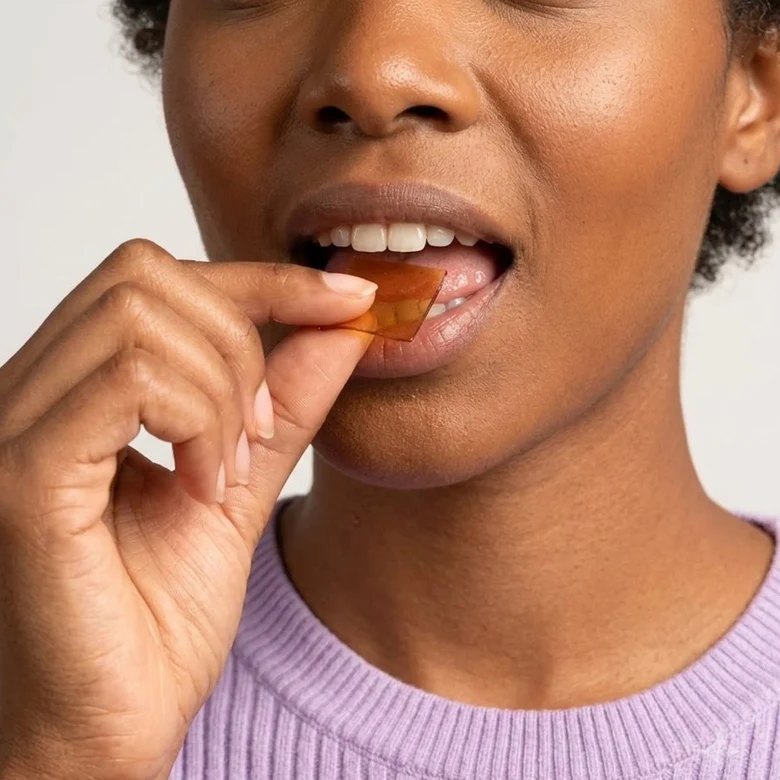
sotto daily: a small pause, in your pocket.
A thin, sugar-free strip that dissolves on your tongue, in a pack that looks like any box of mints. It comes with the free sotto daily app.
What you get
In the pack
Sugar-free strips
A thin strip that melts on your tongue in seconds. No sugar, for anyone keeping an eye on sugar or calories.
Looks like any box of mints
A plain, pocket-sized pack with nothing about weight or cravings on it. Nobody needs to know what it’s for.
In the free app
A 3-minute Reset, for when it gets loud
A short guided pause in the free app, while the strip melts.
How it works
Scan the code on the pack. No account, no sign-in. The app then takes you through three short steps:
- 1 minute focusing on the strip’s taste and coolness, with slow breathing.
- A quick check: how loud is the food noise now, from 0 to 10?
- Still loud? A 2-minute puzzle gives your mind something else to do.
What to expect, and when to see a doctor
Stopping a GLP-1? A plain guide to what’s common, and when to see a doctor.
What’s in the guide
The same code on the pack opens a short, plain-language guide to:
- what’s common in the weeks after stopping, like hunger and food noise coming back
- the signs that mean it’s time to see a doctor
- who to contact for support
Based on official health guidance, such as HAS, Ameli and ANSM in France.
Not a medicine or a meal, and not a way to ignore real hunger. It doesn’t replace a GLP-1 or anything you’re prescribed, and it doesn’t diagnose or treat eating disorders.
What do you think?
Two quick questions, then you’re done.
What would you pay per month?
Strips + app, per month.
Hear from us? (optional)
Saved separately from your answers and only used for what you tick. You can unsubscribe at any time. See our privacy notice.
Optional · 3 more minutes
Got 3 more minutes?
A few questions on food noise, how you manage your weight, and a little about you. Still anonymous.
Thank you.
Reference code:
Keep it if you might want your answers deleted later.
What helps to know
It isn’t willpower
Food noise is a recognised experience that researchers have only recently started to measure.
Notice when it gets loud
Times, places and moods often repeat. Spotting yours makes them less of a surprise.
Give the moment a little room
Cravings tend to pass within minutes. A short walk or something absorbing can help.
Source: Skorka-Brown et al., Addict Behav (2015)Know when to talk to someone
If eating feels out of control, see your doctor. They can refer you to a specialist eating-disorder service.
If you’re on, stopping or have stopped a GLP-1
It’s common for appetite and food noise to come back after stopping. Ask your prescriber for a follow-up plan: stopping the medicine shouldn’t mean stopping your care.
Sources
The research behind this page
- Diktas HE, Cardel MI, Foster GD, et al. Development and validation of the Food Noise Questionnaire (FNQ). Obesity. 2025;33(2):289–297. doi:10.1002/oby.24216
- Hayashi D, Edwards C, Emond JA, et al. What is food noise? A conceptual model of food cue reactivity. Nutrients. 2023;15(22):4809. doi:10.3390/nu15224809
- Dhurandhar EJ, Maki KC, Dhurandhar NV, et al. Food noise: definition, measurement, and future research directions. Nutr Diabetes. 2025;15:30. doi:10.1038/s41387-025-00382-x
- Jovanovic B, Jones N, Zhang F, Holman A, Lowe MR. Food noise among U.S. adults. Preprint, not peer reviewed; 2026. doi:10.21203/rs.3.rs-10997388/v1
- Skorka-Brown J, Andrade J, Whalley B, May J. Playing Tetris decreases drug and other cravings in real world settings. Addict Behav. 2015;51:165–170. doi:10.1016/j.addbeh.2015.07.020